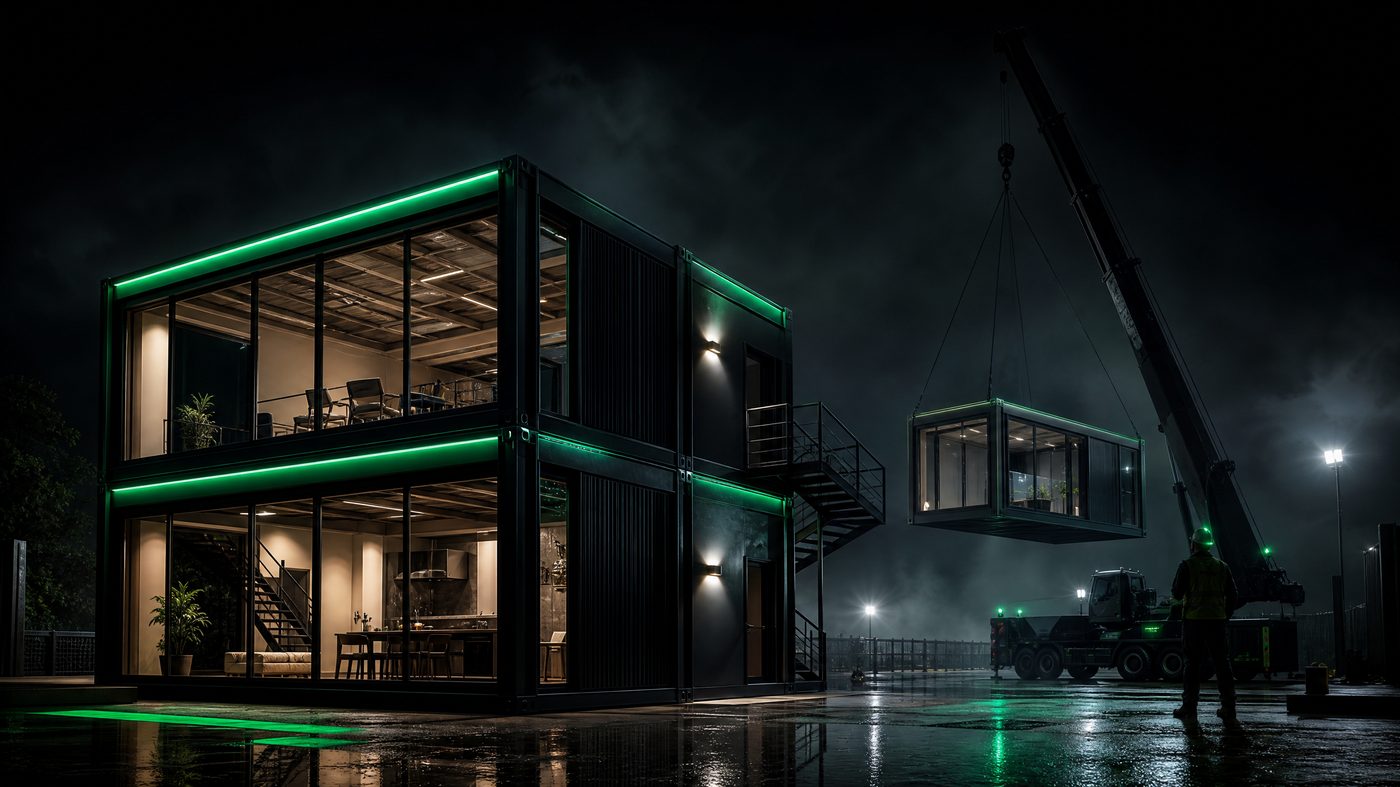
Modular Mining Buildings — Blast-Resistant, MSHA-Ready
Control rooms, dry houses, refuge chambers, labs and change houses. Skid-mounted, relocatable, engineered for the blast overpressure your site actually requires.
Why factory-built wins
Inspected more, not less
There is a persistent assumption that factory-built means less oversight. The opposite is true. Modules are inspected at multiple stations during production by third-party agencies, then inspected again on site after the set. A conventional stick-built house typically sees an inspector four to six times total. A modular unit is checked at every stage where a defect could be hidden by the next layer.
Waste that does not become your problem
A production line orders in bulk, cuts to optimized lengths, and recycles offcuts across dozens of units. Site-built framing typically sends fifteen to twenty percent of delivered material to a dumpster you paid to rent and paid again to haul. Lower waste is part of why the per-square-foot number comes in lower, and it is the part nobody puts in the brochure.
Labor you do not have to chase
The trade shortage is the single biggest schedule risk in construction right now. Factory production concentrates skilled labor in one facility where crews repeat the same operations daily instead of assembling a new subcontractor roster for every project. You are not waiting three weeks for an electrician to have an opening.
Engineering that survives transport
A module has to be structurally sound enough to be lifted by crane, hauled at highway speed, and set without racking. That requirement forces heavier framing, more fasteners and engineered connections than code minimum for a comparable site-built structure. The transport requirement quietly produces a stronger building — which is exactly why factory-built performs well under high wind loads.
Cost certainty instead of change orders
The reason site-built budgets drift is that the price is discovered as the work proceeds. Factory pricing is set when the design is locked, because the production cost of a known module is known. The variable that remains is site work — foundation, utilities, access — which is why we quote that separately and in the open instead of burying it.
Quality you can actually compare
Every unit off a line is built to the same specification with the same crews and the same materials. That repeatability is impossible to achieve across independent site-built projects with rotating subs. If you inspect one finished unit, you have meaningfully inspected the one you are buying.
What it costs
Our delivered-and-installed pricing against published national turnkey figures, July 2026. These are researched estimates for budgeting, not binding quotes.
| 385 sq ft — Studio / 1 bathdelivered & installed | $154,736market $298,800 · save $144,064 (48%) |
| 500 sq ft — 1 bed / 1 bathdelivered & installed | $187,812market $324,800 · save $136,988 (42%) |
| 625 sq ft — 2 bed / 1 bathdelivered & installed | $223,766market $358,800 · save $135,034 (38%) |
| 800 sq ft — 2 bed / 2 bathdelivered & installed | $274,100market $424,800 · save $150,700 (35%) |
| 1,070 sq ft — 3 bed / 2 bathdelivered & installed | $351,759market $464,800 · save $113,041 (24%) |
| 1,195 sq ft — 3 bed / 3 bathdelivered & installed | $387,712market $498,800 · save $111,088 (22%) |
What we build
Every product page carries a full price matrix — new, used and monthly — plus dimensional and CAD references.
How the process actually runs
Discovery and feasibility
We start with what the site will actually allow: zoning, setbacks, utility availability, flood zone, access width for a truck and crane, and whether the jurisdiction has a defined modular pathway. This is where projects get saved or killed, and it costs nothing to find out.
Design and fixed pricing
Layout, finish level and options are locked, and the price for the building is set at that point. Site work is priced separately and transparently, because that is the number that varies with your specific lot and the one most suppliers hide until you are committed.
Permitting in parallel
Plans go to the state modular program or local authority while the site work begins. Running these concurrently rather than sequentially is where most of the schedule advantage lives.
Production
Your unit enters the line. Framing, envelope, mechanical rough-in, insulation, drywall, finish, fixtures and cabinetry happen at successive stations with inspection at each. You get progress documentation rather than guesses.
Site work
Foundation is poured or set, utilities are trenched and stubbed, access is prepared for the delivery truck and crane. This runs while your unit is in production.
Delivery and set
Modules are transported and craned onto the foundation. For a single-module building this is typically a matter of hours, not days — the set itself is the fastest part of the entire project.
Button-up and closeout
Marriage lines are joined, mechanicals and utilities are connected, exterior finishes are completed at the seams, final inspection is called, and you get your certificate of occupancy along with documentation.
Where we deliver
Every state has its own code pathway, freight distance and cost index. We publish all of it.
What people get wrong
“You cannot get financing”
Conventional, FHA, VA and USDA products all finance modular construction on a permanent foundation. What differs is the draw structure: factories require deposits at order and progress payments during production, which does not match a standard construction draw schedule. That mismatch is a paperwork problem, and lenders who do this regularly have products for it.
“It is cheap construction”
The cost advantage comes from process — bulk purchasing, reduced waste, no weather delays, concentrated labor — not from thinner materials. Transport loads actually require heavier framing than code minimum. If someone is selling you a low number by reducing specification, that is a supplier problem, not a modular problem.
“Resale is harder”
Once set on a permanent foundation and deeded as real property, a modular home sells through the same MLS process as any other house. Most buyers cannot identify a finished modular home from the exterior, and most listings do not distinguish. The resale objection is a holdover from confusing modular with manufactured housing.
“Modular means mobile home”
These are different legal categories with different codes. A manufactured home is built to the federal HUD code, arrives on a permanent steel chassis, and is titled like a vehicle. A modular building is built to the same state and local building code as site-built construction, is set on a permanent foundation, and is deeded as real property. Modular appraises, finances and insures as a house. That distinction affects your loan, your taxes and your resale.
Common questions
How much does modular mining buildings cost?
How fast can you actually deliver?
Why is your pricing lower than the national builders?
Is this a modular home or a manufactured home?
What is not included in the price you show?
Can I see the numbers before talking to someone?
Get a Modular Mining Building quote
Tell us the scope and the ZIP. You get a real delivered-and-installed number, not a "contact us for pricing" runaround.
More from the network
We run a group of focused sites so you land on the one that matches what you actually need instead of a catch-all catalog.